The Story in Brief
Mexico disappeared families protest movements took center stage in the capital city today as the globe focused on the FIFA World Cup inauguration. Hundreds of grieving relatives, representing an estimated 135,000 missing individuals across the country, marched through Mexico City to demand urgent government action. The demonstrators utilized the massive international spotlight of the football tournament to highlight their agonizing search for loved ones, criticizing bureaucratic delays and the millions invested in the sporting event while their cases remain largely ignored.
Mothers Lead the Charge Amidst Global Celebrations
The demonstrations were primarily led by grassroots organizations known locally as “madres buscadoras” or searching mothers. These dedicated activists bused into the capital from various surrounding states late Wednesday to participate in an emotional candle-lit vigil. This quiet mourning eventually transitioned into a large-scale march heading directly toward the Mexico City Stadium just hours before the opening kickoff.
For many of these families, the frustration stems from years of navigating a completely stalled and unhelpful legal system. Hector Aguila, a 59-year-old organizer for the Jalisco-based search group Luz de Esperanza, has been desperately looking for his missing son since 2023. Speaking to reporters outside a bustling fan zone in the city’s main square, Aguila clarified the group’s stance. He emphasized that the families are not against the World Cup or the international fans visiting to enjoy the festivities. Their anger is directed at a government that willingly invests millions of pesos into a sports party while leaving the families of the missing to suffer in total oblivion.
Alexandra Campa, another searcher from the highly violent state of Jalisco, echoed this tragic sentiment. Having searched for her younger brother for over a year, she told reporters that seeking official help from the state felt like a complete waste of time. She noted that authorities constantly change lawyers, leaving thousands of desperate cases without any real solutions or forward momentum.
Peaceful Marches Turn to Clashes at the Stadium
The day’s events initially began peacefully. Collectives marched through the streets wearing white shirts or the iconic green Mexican national football jerseys, but with a heartbreaking twist—the shirts were printed with photographs of their missing children and siblings.
However, as the afternoon progressed and the crowds swelled near the stadium, the underlying tension finally boiled over. Certain groups within the protest tore down physical security fences and clashed directly with law enforcement. This sudden escalation prompted authorities to deploy hundreds of heavily armored riot police to secure the streets surrounding the sports venue.
The national government continues to attribute this massive wave of disappearances primarily to organized crime and cartels. Officials frequently link the missing persons crisis to the extreme violence generated by former President Felipe Calderon’s militarized “war on drugs” which began in the late 2000s. While state representatives claim that locating these missing citizens remains a top national priority, the reality on the ground tells a very different story.
Activists Send a Message to the International Community
Critics and human rights defenders argue that weak state support and massive institutional backlogs force regular families to conduct searches entirely on their own. These independent search efforts often take them into notoriously dangerous cartel territories, a horrific reality that has resulted in the murder of several prominent activists. They also point out that the sheer volume of unresolved cases deliberately obscures the true scale of deadly violence currently plaguing Latin America’s second-most populous country.
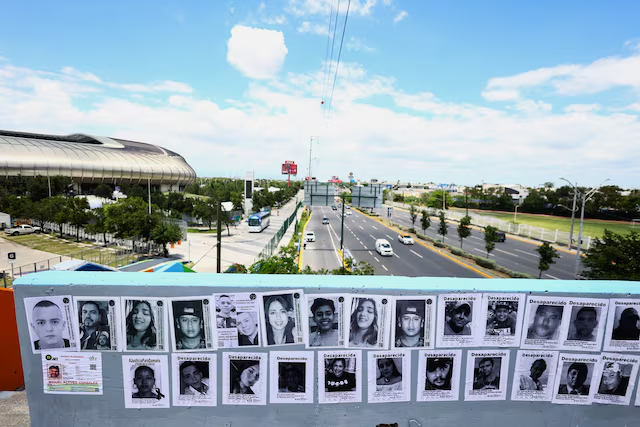
To ensure their message reached the influx of international tourists, activists executed a highly coordinated visibility campaign ahead of the inaugural match. Thousands of missing person posters were plastered across busy roundabouts and along the public train tracks leading to the main stadium. Protest graffiti covered bus stops and city walls, featuring powerful slogans like: “The ball is coming home, but when will our children?”.
Even the city’s most famous monuments became sites of protest. At the Angel of Independence, while tourists snapped photos and a performer danced to the official World Cup anthem by Shakira and Burna Boy, the reality of Mexico’s crisis was etched in stone. The word “heroes” on the statue’s tablet was firmly crossed out and replaced with a single, haunting word: “desaparecidos” (the disappeared).
Sources: Reuters, BBC News, Al Jazeera, Human Rights Watch, The Guardian, Mexico City Local News.